Business & Innovation · news
Greg Leffel and the Virginia Blockchain Council bring a community voice to technology policy
From grassroots gatherings to work with Gentry Locke and national and international organizations, the council is helping Virginia’s blockchain community take part in the policy conversation.
For Greg Leffel, building Virginia’s blockchain community has meant bringing people together—and making sure their experience reaches the rooms where public policy takes shape.
As founder and executive director of the Virginia Blockchain Council, Leffel has helped connect a grassroots technology community with lawmakers, legal advisers and organizations beyond the commonwealth. The council’s work gives entrepreneurs and people curious about blockchain a place to learn, while giving policymakers an organized group to engage with as digital assets raise new questions for business and government.
The nonpartisan nonprofit council grew out of a Bitcoin and blockchain meetup and took its current form in 2022. Its three priorities—advocacy, community and education—describe a practical approach: convene people, improve understanding and keep the conversation going when policy becomes complicated.
Bringing the community into the policy conversation
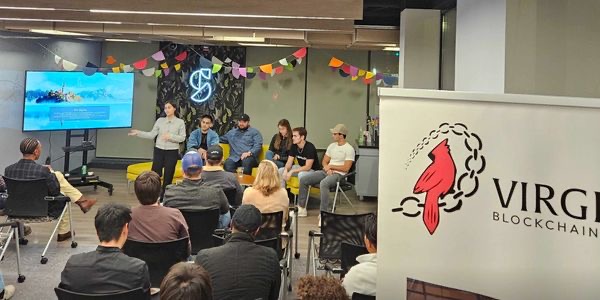
Leffel’s involvement is documented in Virginia’s legislative record. In July 2024, he appeared before the Joint Commission on Technology and Science, known as JCOTS, to discuss the council’s planned Government Blockchain Showcase in Fairfax. The meeting summary records an effort to introduce public officials to real-world uses of the technology.
He subsequently served on JCOTS’s 2025 Blockchain Advisory Committee. The commission’s annual report lists him among the committee’s members and describes five meetings examining issues including regulatory sandboxes, decentralized autonomous organizations and virtual-currency kiosks.
These are consequential questions about how emerging businesses should operate and how the public should be protected. Participation does not make every proposal law. It does, however, show Leffel doing the sustained work of helping an unfamiliar technology become a subject that legislators can examine in detail.
Working with Gentry Locke
The council strengthened that policy effort through a collaboration with Gentry Locke and Gentry Locke Consulting, announced in March 2025. The partnership brought the council together with legal and government-affairs professionals to engage lawmakers and other stakeholders on blockchain policy.
In the partnership announcement, Leffel described a policy environment that “supports growth while maintaining integrity and security.”
Gentry Locke Consulting’s financial-technology practice continues to list the council among the organizations it represents. Its team includes Greg Habeeb and Zach LeMaster, both named in the original announcement. The firm describes its work as balancing innovation with consumer protection and market stability—a useful foundation for an industry whose long-term prospects depend on public confidence as well as technical ambition.
A Virginia organization with a wider reach
The council’s relationships extend beyond the state capitol. It identifies itself as a founding member of the U.S. Blockchain States Coalition, connecting its Virginia work with a broader network of state organizations.
Internationally, the Switzerland-based BSV Association lists the council as an outreach partner. Leffel has also been featured in a Global Blockchain Business Council Tech for Impact speaker program, addressing Uniform Commercial Code amendments and Article 12, part of the evolving legal framework for digital assets.
Those connections bring a Virginia voice into wider discussions while keeping the council rooted in community building at home. For Leffel and the organization he leads, the contribution is visible in the work itself: convening people, explaining difficult ideas and giving Virginia’s blockchain community a consistent presence in the policy conversation.
Learn more about the council’s programs and community at vablockcouncil.org.